Action Bronson x Statik Selektah’s collaborative LP “Well Done” drops on DCide/ShowOff Records. The album is dope and here’s the video for “Not Enough Words”

After a 2-15 start, the Washington Wizards fired coach Flip Saunders on Tuesday, replacing him with assistant coach Randy Wittman through the end of the season.
Saunders was in the third year of a four-year, $18 million contract.
"I felt like at this time, our players were not responding, and I think we needed a different voice. This doesn't change our overall plan, which always has been very transparent for us, which is to build through the draft, get salary-cap space going forward and develop our young players," Wizards president Ernie Grunfeld said. "They probably haven't developed as quickly as we'd like for them to develop. That's something we need to continue to work on."
Grunfeld and Wittman spoke about playing a faster-paced, running game on offense and perhaps using more press tactics on defense. They also emphasized that younger players, whom they did not mention by name, need to understand that floor minutes are not guaranteed.
"We have to develop these kids, there's no question about it," Wittman said. "There comes a point, if you know you're going to be out there, you'll play whatever way you want to play. And I think that has to change a little bit."
The Wizards' management had hoped to avoid firing Saunders, even as the club lost its first eight games. But the team's continued poor play, combined with the regression of 2010's No. 1 draft pick John Wall, left the team with no choice.
Wall is averaging 7.2 assists per game this season, nearly a full assist less than the 8.3 per game he averaged in his rookie season. His shooting percentage has declined to .379 from the field this season from .409 in 2010-11.
"He is a talented player that I think I need to coach -- and he has to be willing to be coached," Wittman said of Wall. "And if he does that, that's where good players become great players."
Wall hasn't gotten much help from his Wizards teammates, who have been prone to inconsistent play. On Monday in a 20-point loss to the Philadelphia 76ers, they walked down the court for offensive possessions, failed to hustle after loose balls and missed eight of nine shots in the paint in the first quarter.
After one string of sloppy plays, Saunders took a knee in front of the scorer's table, bowed his head and rubbed his temples.
After the game, Wall said: "Whoever got the ball just took a shot. Guys are holding their heads down, and we're not fighting or competing."
While the Wizards have plenty of young, talented players, they have shown a lack of discipline and Saunders could not seem to get through to them.
Earlier in the season, the players held a team meeting in which the younger players asked the veterans to tell Saunders they wanted him to hold them more accountable, according to sources. The veterans discussed it with Saunders, but after more than two seasons of his softer approach, it was perhaps too late for him to gain control of his roster.
The Wizards tried Saunders' patience from the start, blowing a 21-point lead to the New Jersey Nets in their season opener. Afterwards, Andray Blatche voiced displeasure over the offensive play calling and later, on Twitter, told those criticizing him to "shut up."
In a home loss to the Houston Rockets on Jan. 16, a visibly annoyed Saunders sat JaVale McGee for the final nine minutes after McGee alley-ooped to himself off the backboard on a breakaway dunk. McGee responded by defending the play to reporters, saying "Apparently if you get a fast break and throw it off the backboard in the third quarter and you're 1-11, you're not supposed to do stuff like that."
Washington was Saunders' third coaching stop. In 16 seasons with Minnesota, Detroit and Washington, the 56-year-old Saunders compiled a 638-526 record, including 51-130 with the Wizards. He reached the playoffs 11 times, including three straight seasons with the Pistons, and cracked the 50-win plateau seven times.
Wittman, 52, has more than four years of previous head-coaching experience. In two years in Cleveland and three in Minnesota, he posted a record of 100-207. In his last stint, with Minnesota, he was fired after the Timberwolves started the 2008-09 season 4-15.
The Wizards, who have lost seven of their last eight games, host the Charlotte Bobcats on Wednesday.

Any discussion regarding Joe Paterno was far easier a few months ago. A few days after his death, it remains difficult to comprehend how one of the least complicated men in sports left the world with such a puzzling, confounding legacy.
From now until forever, it will be impossible to separate Paterno from the Jerry Sandusky scandal. Paterno's own words -- I wish I'd done more -- are a sad, conflating addendum to a life that did much good.
Still, far too many tributes to Paterno have suggested his death is the end of some undefined age of innocence, that it closes the book on an age when grand ideals went before money or wins or expedience. That all sounds nice, but it's a fairy tale. The regurgitation of the Paterno-as-moral-messiah(-until-Sandusky) fable is what happens when people close their eyes and see the world the way they thought it was, or how they want it to be. The past few months should have taught everybody -- even the most defiant Paterno defender -- a new truth: Those ideals were either dead long ago or never existed in the first place.

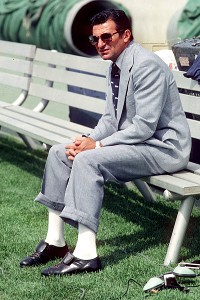
Paterno was the perfect symbol of his generation. He was the guy for all the old guys, the ones who prefer solid football over flashy helmets or shiny shoes. It went deeper than football, though. He looked like the guys who worked down at the plant, and he dressed on the sidelines as if he were going to head over for 5 o'clock Mass after the game.
He didn't come from an age when men scheduled therapy sessions or retired to the woods to beat on drums and assess their self-worth. The men in Paterno's life, I'm guessing, were a lot like my father: World War II vets who did their service, came home and worked their butts off to make their kids' lives better than theirs. What they didn't do, unfortunately, was talk about it. They deflected war talk and hero talk with the same dismissive tone Paterno might use to address a reporter in a news conference.
(Men of Paterno's era kept a lot bottled inside, too, often to their detriment. This was a real world, not the smarmy, sepia-toned world proffered by maudlin nostalgia-peddlers like Tom Brokaw.)
This much seems indisputable: Paterno is the last of the Cold War coaches. His generation valued stability far more than those that have followed. Men raised in Depression and post-Depression America seemed to go about their business the same way: Get good work, be thankful for it and stick with it. Stay at the same job, with the same woman, in the same house. Don't go wandering, or getting big-headed, or thinking you're more than you are. Don't get greedy, don't take chances, don't show off. Risk is for other people.
(And if you don't see a correlation between these themes and Paterno's play calling, that'sMike Guman on line two.)
Paterno had just one publicly restless moment, and he quelled it by turning down the Patriots in 1973. Contrast that with nearly every major college coach since, with Oregon coach Chip Kelly's dalliance with Tampa Bay the latest. It never seemed to be about morefor Paterno. He had what he needed, including enough money to give away tons of it.
He was the ultimate match of man and region; central Pennsylvania is central Indiana, without the glitz. Paterno wasn't always humble -- "The Grand Experiment" was his term, remember -- but JoePa's people were.
More importantly, Paterno was the last coach of the pre-irony age. He simply wasn't built for a cynical world. It was worse than that, really: He couldn't understand it, or abide by it. All that commentating, all that know-it-all snark -- his voice would rise an octave or two, he'd swat a hand into the air. Ah, people can say what they want to say. I don't pay any attention to it. His world was direct and unfettered by doubt or -- until the last few months -- regret.
The times changed, but he didn't. He didn't know why journalists asked questions about players who acquired criminal records, and he didn't understand why compliance people at Penn State thought they should have a say in adjudicating every little transgression. This was generational, also, with more than a little brand-protection built into the equation. He could handle it himself -- what's the big deal?
Everything Paterno constructed was simple. Men of his generation dealt with their own problems their own way, which usually meant they didn't ask many questions and didn't stray too far into anybody else's business.
They kept it simple. Simple is easy, straightforward, easy to define. And every so often, simple gets complicated.